Which Industries Are Most Vulnerable to Phishing?
Some industries attract far more phishing than others, but what makes a sector a target and how likely its people are to fall for an attack are two different things.

Search for the industry most vulnerable to phishing and you will get a different answer from almost every report. One says manufacturing. Another says finance. A third says education. They cannot all be right, but in a way they all are.
The disagreement comes down to what each report measures. Some count how often a sector is attacked. Some count how often it is breached. Some count how often its people click. Those are three different questions, and they produce three different league tables.
What these reports rarely tell us is how people actually respond when a phishing email arrives. That is what we looked at, across a year of phishing simulations sent to 123,692 employees in SMB and mid-market organisations, measured the same way for every sector.
What the behaviour data shows
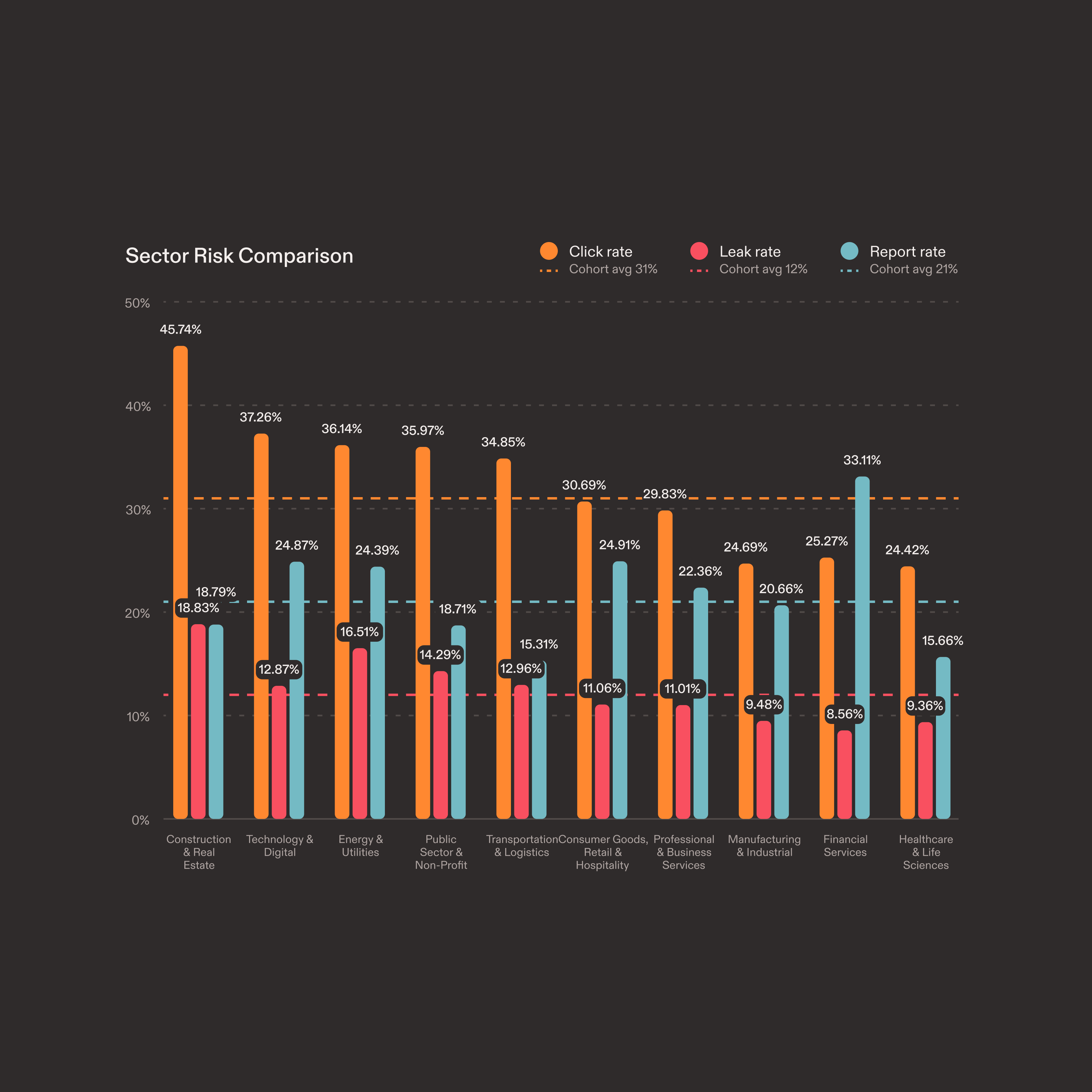
We tracked three behaviours, each a different stage of the phishing response. Click rate is susceptibility to the initial lure. Credential leak rate is how many go on to hand over their details. Reporting rate is how many recognise a suspicious email and flag it. Each figure is cumulative and per-user: the share of people in a sector who did that thing at least once across the year, not a rate per email.
Measured this way, the gap between sectors is wide. Cumulative click rates ranged from 24.42% in Healthcare and Life Sciences to 45.74% in Construction and Real Estate. Construction had the highest click and credential leak rates, the latter at 18.83%. Financial Services was the strongest all round: the lowest leak rate, at 8.56%, and by far the highest reporting rate, at 33.11%.
Most targeted is not most vulnerable
Here is where the external data and the behaviour data pull apart. By attack volume, manufacturing is one of the most-targeted sectors of all; IBM's 2025 X-Force Threat Intelligence Index found it the most-attacked industry for the fourth year running, at 26% of the incidents it observed. Yet in our data, manufacturing had among the lowest click and leak rates of any sector.
Being attacked often and being likely to click are not the same thing. Attackers target a sector because of what it is worth to them. Whether the attack works depends on how the people there respond. A sector can attract a flood of attacks and still have people who rarely click, while another, targeted far less, can be more exposed.
A closer look at the sectors
Construction and Real Estate. The sector with the highest click and leak rates in our data, and it is not hard to see why it is a target. Construction runs on a constant flow of invoices, supplier requests and project communications, often between parties who have never met in person. That makes a fake invoice or a spoofed supplier email easy to slip in unnoticed, which fits what we saw: the highest click rate at 45.74%, and the highest leak rate at 18.83%.
Financial Services. Among the most heavily targeted sectors anywhere, for the obvious reason that it sits closest to the money. Yet it was our strongest performer, with the lowest leak rate and the highest reporting rate of any sector. That performance may reflect the sector's long-standing investment in security awareness, alongside the regulatory scrutiny and controls common in financial services. It is the clearest sign that heavy targeting and high vulnerability do not have to go together.
Energy and Utilities. A sector where a single click can reach systems that keep the lights on. Energy had an above-average click rate, but the more telling figure is what happened next. Among the people who clicked, roughly 46% went on to submit their credentials, the highest such ratio in the dataset. It is a reminder that the click rate alone does not tell the whole story: what people do after they engage with a suspicious email matters just as much, and where credential access reaches operational systems, it matters more.
Manufacturing. The most-targeted sector by volume, yet, despite the attention from attackers, employees in our manufacturing sample were among the least likely to click or disclose credentials. It is the gap between targeting and vulnerability in a single example.
Education. Education does not appear as its own sector in our dataset, but it is one we work closely in, and the external picture is hard to ignore. The UK government's 2025/26 Cyber Security Breaches Survey found that 98% of higher education institutions and 88% of further education colleges had identified a breach or attack in the previous year, far above the rate for businesses overall, with phishing the most common attack. The characteristics are all there: sensitive research and student data, a large and constantly changing population of students and staff, and open, high-contact communications by design. It is an easy sector to reach, which makes how its people respond all the more important.
What makes an industry attractive to attackers?
Step back from any single sector and a pattern emerges in what attackers find appealing. It tends to come down to a handful of characteristics. The matrix below is illustrative, a way of showing the kinds of traits that draw attention, rather than a formal assessment of each industry.
The more of these apply, the more appealing an organisation is to attackers, whatever its size. But notice what the matrix does not tell you: how your people will respond. That is the part you control.
What this means for your business
You cannot always control why attackers target your business. If you hold money, sensitive data or operate a complex supply chain, you are likely to attract attention.
What you can influence is how your people respond when an attack reaches them.
The differences between sectors show why it is worth looking beyond attack volumes to understand actual behaviour. A high level of targeting does not automatically mean a workforce is more susceptible, just as a lower level of targeting does not mean an organisation is less exposed.
Building resilience means understanding where people are most likely to make mistakes, giving them the right support, and measuring whether their behaviour improves over time.
Download the full Phishing Behaviour Report 2026 to explore click, credential leak and reporting rates across every sector, and see how your organisation compares.
Pistachio helps organisations build that resilience with personalised phishing simulations and awareness training that adapts to each employee and runs without ongoing campaign administration.
Book a 15-minute demo to see how it works.

Download the Phishing Behaviour Report 2026
Why a One-Size-Fits-All Security Awareness Programme Leaves Teams Exposed

Continue reading
Ready to reduce your human risk? Book your demo today.
“We lacked confidence that employees would recognise today’s phishing threats or respond correctly. Since using the Pistachio platform, they are more attentive and proactive in identifying potential risks. The solution is easy to manage, quick to implement, and highly effective.
“The platform is easy to implement and provides clear insights into employee phishing awareness. Its bite-sized learning encourages participation, saves administration time, and allows us to focus more on real threat detection.”
“We were looking for a practical way to improve cybersecurity awareness across the organization. Pistachio made training simple and engaging, and we’ve seen a noticeable improvement in employee awareness with minimal effort.”
“Pistachio removed the burden of planning campaigns, collecting data, and evaluating results. The program challenges each employee at their own level and provides clear, simple reporting. Pistachio has streamlined our awareness training and strengthened our organization’s cybersecurity.”
“Our goal was to help employees better recognize phishing emails and avoid malicious links. Pistachio made this easy and engaging, and we’ve seen a clear improvement in detection, fewer clicks on phishing links, and reduced data disclosure. With minimal ongoing maintenance, it’s an effective and low-effort solution.”
“Within weeks, Presence had flagged several incidents that could have otherwise been missed, including employees forwarding company data to personal accounts during offboarding. The alerts are reliable and actionable, so we've built a full investigation process around them. Although I was skeptical at first, the value was obvious almost immediately.”
“Pistachio has reduced our manual workload to zero with its automated phishing simulations and in‑box delivery of scenario‑based trainings. This has allowed our team to dedicate time to other important security initiatives while Pistachio handles our Security Awareness program seamlessly.”
“Presence automatically detects suspicious behaviour and gives us the visibility we need without constant manual oversight. Within the first few weeks we were already seeing alerts that would have otherwise gone unnoticed as the system learns what is usual and unusual behaviour for our environment.”
“Before Pistachio, security awareness was something we could only offer to a few customers. Today it’s part of every managed service we deliver, and we haven’t had to grow the team to make that happen.”
Fill out the form to book a demo:
Trusted by 1200+ customers & MSPs