Why a One-Size-Fits-All Security Awareness Programme Leaves Teams Exposed
A year of phishing data shows departments respond very differently to the same tests, so a one-size-fits-all programme leaves some teams better protected than others.
Most security awareness programmes run the same way for everyone: the same simulations, at the same frequency, for every team. That approach is understandable, particularly for a lean IT team that cannot build a separate plan for every employee. But it also assumes that everyone responds to phishing in much the same way.
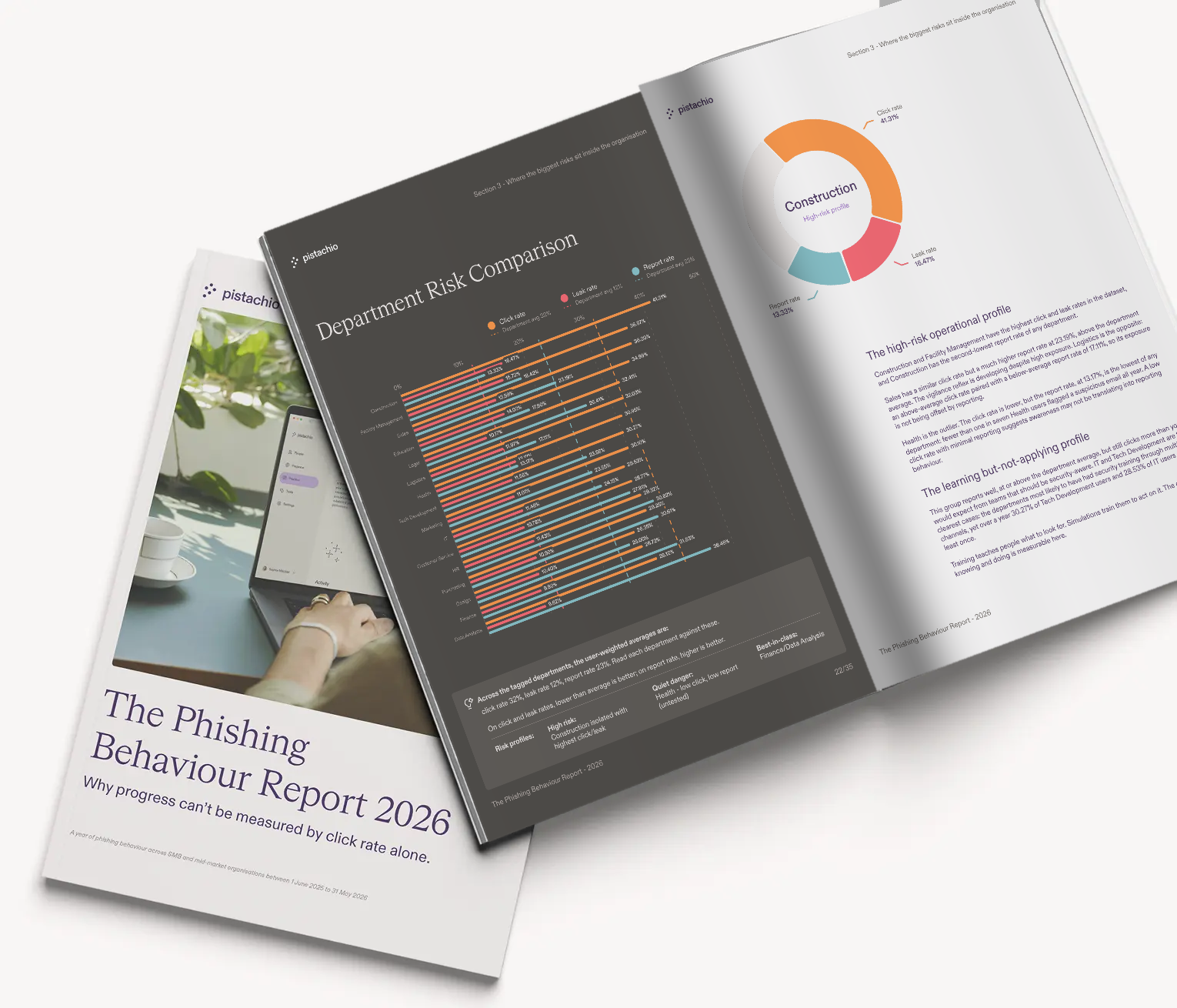
We analysed a year of phishing behaviour across 123,692 employees in SMB and mid-market organisations, broken down by department. Every department received a near-identical mix of test difficulty, yet how they responded varied enormously.
One business, several risk profiles
Across the sixteen departments we tracked, cumulative click rates ranged from 26.35% in Design to 41.31% in Construction. Reporting ranged even more widely, from 13.17% in Health to 36.45% in Data Analysis. These are per-user figures over the year: the share of people in each team who clicked, or reported, at least once.
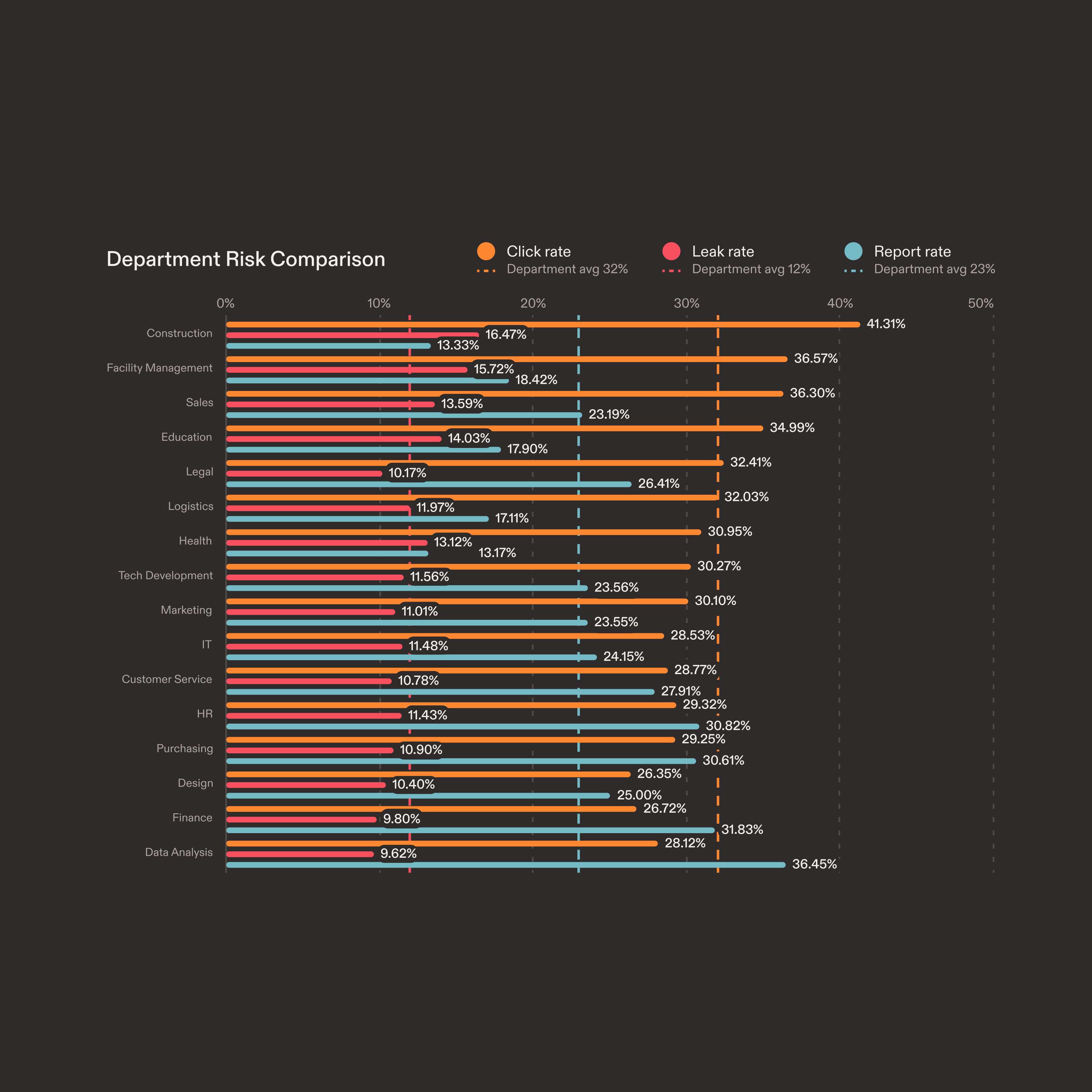
Because the difficulty was broadly the same across departments, the variation gives us a useful comparison of how people in different roles respond to similar phishing tests. A single organisation-wide click rate hides all of this.
What a uniform programme misses
A uniform programme gives the same treatment to a team where 41% of people clicked at least once and one where the figure was 26%. A team with a higher click rate may need more focused support, while another might need to work on recognising and reporting suspicious messages. Running an identical programme for both means spreading the same effort across teams with different needs, leaving some more exposed than others.
There is a well-known argument that generic training fails because it prepares people for fake threats rather than real ones. This is a simpler, more measurable version of the same problem: even with identical, realistic testing, your teams are not in the same place, so one programme cannot be right for all of them.
The quiet-department trap
One pattern here is easy to misread. It is tempting to read a low click rate as a team doing well, but click rate on its own can mislead at department level too.
Health is the clearest example. It had a below-average click rate, which looks reassuring, alongside the lowest reporting rate of any department: 13.17%, fewer than one in seven people flagging a suspicious email all year. A team that rarely clicks and rarely reports is not necessarily demonstrating strong security behaviour. It could indicate that employees are not recognising suspicious messages, are not confident enough to report them, or simply are not engaging with the reporting process.
What to do with the differences
The practical step is to stop looking only at the organisation-wide click rate and start reading each team across all three behaviours. Where a department clicks more, it may need more focused support. Where it clicks little but reports little too, the question is whether its people would recognise a real attack at all.
Segmenting by team is a start, not the finish. A department rate is itself an average, so within any team some people click far more often than others, and some report far more than their colleagues. Calibrating to the team gets you closer than a single company-wide number. Calibrating to the person gets you closer still.
Your organisation does not have one phishing risk profile. Every team, and every person within it, responds differently, and an effective awareness programme needs to recognise those differences and adapt to them.
See how Pistachio uses individual behaviour to adapt phishing simulations automatically, giving every employee the support they need without adding work for IT. Email contact@pistachioapp.com to book a 15-minute demo.

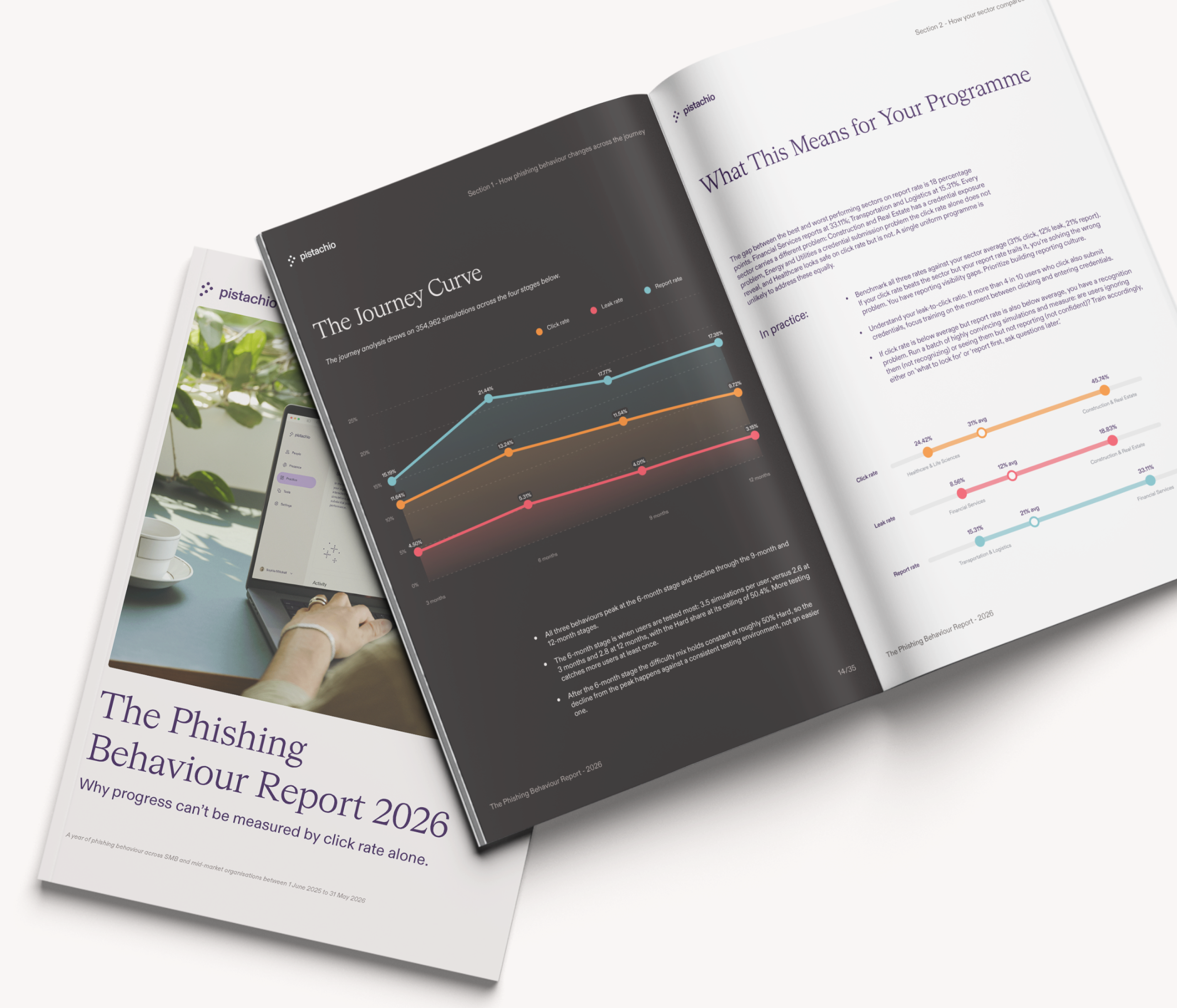
Download the Phishing Behaviour Report 2026
Why a One-Size-Fits-All Security Awareness Programme Leaves Teams Exposed

Continue reading
Ready to reduce your human risk? Book your demo today.

“We lacked confidence that employees would recognise today’s phishing threats or respond correctly. Since using the Pistachio platform, they are more attentive and proactive in identifying potential risks. The solution is easy to manage, quick to implement, and highly effective.
“The platform is easy to implement and provides clear insights into employee phishing awareness. Its bite-sized learning encourages participation, saves administration time, and allows us to focus more on real threat detection.”
“We were looking for a practical way to improve cybersecurity awareness across the organization. Pistachio made training simple and engaging, and we’ve seen a noticeable improvement in employee awareness with minimal effort.”
“Pistachio removed the burden of planning campaigns, collecting data, and evaluating results. The program challenges each employee at their own level and provides clear, simple reporting. Pistachio has streamlined our awareness training and strengthened our organization’s cybersecurity.”
“Our goal was to help employees better recognize phishing emails and avoid malicious links. Pistachio made this easy and engaging, and we’ve seen a clear improvement in detection, fewer clicks on phishing links, and reduced data disclosure. With minimal ongoing maintenance, it’s an effective and low-effort solution.”
“Within weeks, Presence had flagged several incidents that could have otherwise been missed, including employees forwarding company data to personal accounts during offboarding. The alerts are reliable and actionable, so we've built a full investigation process around them. Although I was skeptical at first, the value was obvious almost immediately.”
“Pistachio has reduced our manual workload to zero with its automated phishing simulations and in‑box delivery of scenario‑based trainings. This has allowed our team to dedicate time to other important security initiatives while Pistachio handles our Security Awareness program seamlessly.”
“Presence automatically detects suspicious behaviour and gives us the visibility we need without constant manual oversight. Within the first few weeks we were already seeing alerts that would have otherwise gone unnoticed as the system learns what is usual and unusual behaviour for our environment.”
“Before Pistachio, security awareness was something we could only offer to a few customers. Today it’s part of every managed service we deliver, and we haven’t had to grow the team to make that happen.”
Fill out the form to book a demo:
Trusted by 1200+ customers & MSPs